
Students often hear the phrase “question bank” and imagine something large, formal, or highly technical. In practice, a personal question bank can be much simpler and much more useful than that. It is just a structured place where the student collects the questions that matter most during exam preparation: the doubts that keep returning, the concepts that still feel unstable, and the answers that finally make a chapter click.
That is important because exam prep is not only about reviewing content. It is also about refining judgment. Students need a way to see which parts of the course are still generating confusion and which explanations have already been resolved well enough to trust. A personal question bank helps create that visibility. It turns scattered uncertainty into reusable study material.
What a personal question bank should actually contain
A good question bank is not a giant list of everything the course could possibly ask. That usually becomes too broad and too static to help. The stronger version is built from the student’s real study process. It contains the questions that emerged while reading, attending class, reviewing notes, solving exercises, or discussing the course with classmates.
That makes the bank much more honest. It is not pretending to represent the entire discipline perfectly. It is capturing the parts of the course that still require effort. One question may be conceptual. Another may be definitional. Another may reflect a mistake that keeps happening when the student tries to apply the theory. Together, those questions reveal where understanding is still uneven.
Why students need more than one loose Q&A document
Many students already do something similar in a very temporary way. They keep a list of questions in a note, or a few screenshots, or one chat thread with a classmate who explains difficult sections. The problem is not the instinct. The problem is that the material stays fragile. It is hard to retrieve, hard to update, and rarely tied back to the chapter it belongs to.
This is why a proper question bank needs structure. Questions should stay close to the course, not beside it. When a question is connected to the right topic, it becomes easier to revisit alongside the notes, files, and other questions for that same chapter. That context is what turns a loose doubt into part of the exam workflow.
How to build the bank from real study friction
The best starting point is not to write new questions from scratch. It is to capture the questions that already appear during studying. Every time a chapter feels unclear, the student can save the doubt in a more durable form. Every time a past paper exposes a weak answer, that weakness can become a new question. Every time one explanation works better than another, the stronger version can stay attached to the question rather than disappearing into memory.
Over time, the question bank becomes a record of how the course was actually learned. That is far more useful than a generic summary because it reflects the real pressure points of the material. It also gives revision a much sharper focus. Instead of reviewing a chapter only because it feels vaguely difficult, the student can see exactly which questions still make it feel unstable.
A Supastudy workflow example
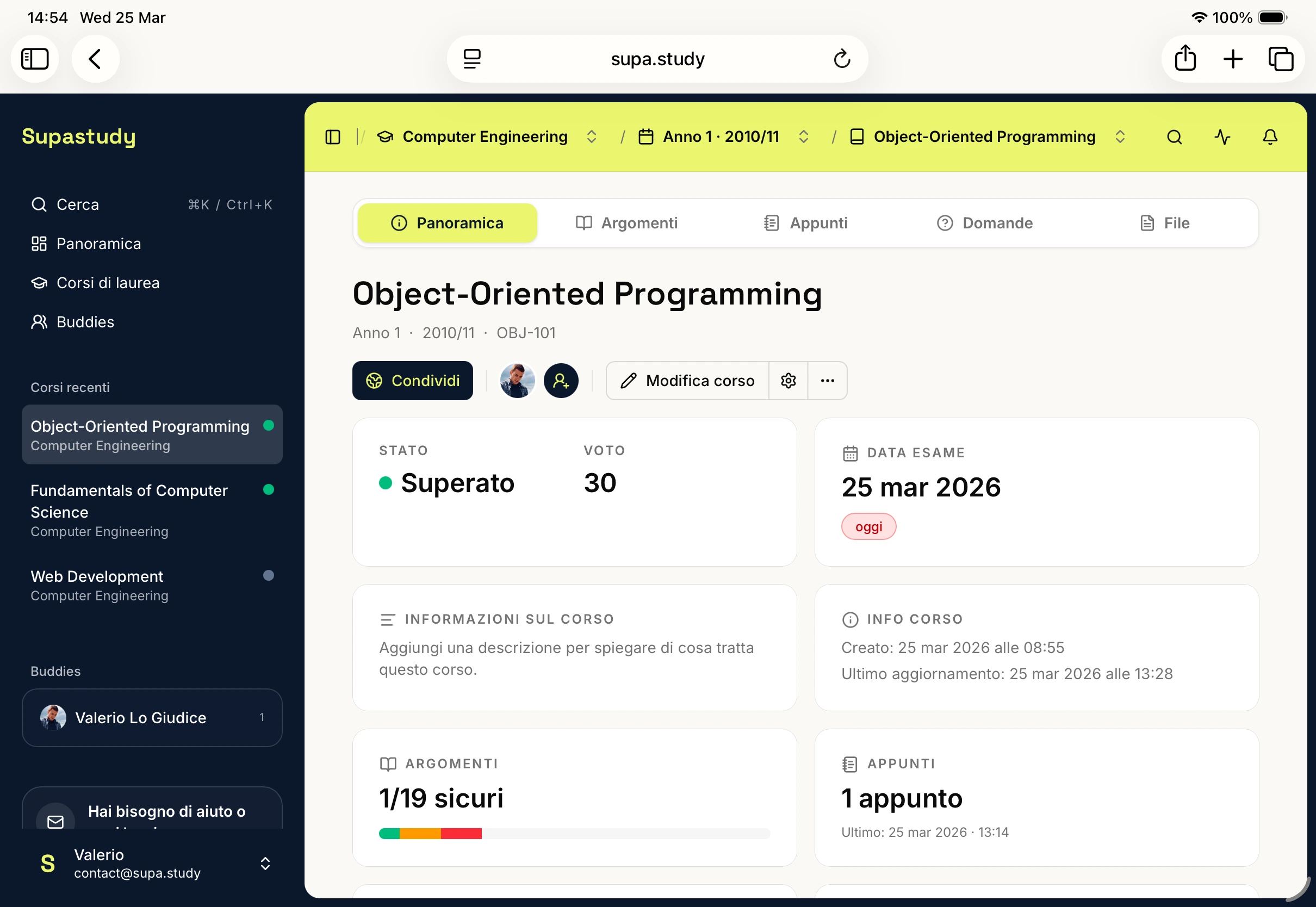
In Supastudy, a practical question-bank workflow starts by saving open questions directly inside the course as they appear. Each question can be linked to the relevant topic, which means it stays tied to the same structure as the notes and files that might help resolve it. As the student studies, answers can be added and improved. If the course is shared, several classmates can contribute explanations, and the clearest one can eventually be treated as the accepted answer.
This is what makes the question bank feel cumulative rather than temporary. A good answer does not vanish into chat, and a difficult doubt does not disappear into a margin note. The question remains visible, attached to the chapter, and available for later review.
Why a question bank improves exam readiness
The biggest benefit is not only organization. It is sharper revision. A strong question bank tells the student where the fragile parts of the course still are. If one topic has several unresolved questions, it probably needs more than a quick reread. If another topic has clear answers attached to every major doubt, it may only need a lighter review pass.
That makes the question bank a planning tool as well as a study tool. It helps the student decide what still needs deeper attention, which chapters are becoming more secure, and where the next session should go. In that sense, it becomes part of the same logic as topic readiness and exam planning. It is one more signal that turns vague pressure into specific action.
How to keep the bank useful instead of overwhelming
The main risk is turning the question bank into another pile. That usually happens when students save too many vague prompts, keep questions detached from the course structure, or never revisit old entries. The solution is not to collect less. It is to keep the questions specific and contextual. A useful question should be clear enough that it can eventually be answered and stable enough that it helps future revision.
It also helps to accept that not every question deserves the same level of detail. Some can be answered quickly and moved on from. Others are important enough to become reusable exam material. The value comes from keeping the meaningful ones visible, not from creating the largest possible collection.
What to read next
If you are still losing doubts before they make it into a system, read How to Keep Track of Open Questions While Studying. If you want the broader exam-planning context, go to How to Build an Exam Study Plan From Your Syllabus. If your question bank mostly grows through shared work, How to Study With Classmates Without Losing Materials in Chat is the right next read. For the role and workflow side of collaboration, see Viewer, Member, Moderator, Owner: The Right Roles for a Study Group.
Final takeaway
A personal question bank becomes powerful when it grows out of real doubts inside the course. It helps students keep confusion visible, preserve good answers, and revise with much better focus than a loose archive of notes ever could.
If you want to build that kind of exam workflow inside one course workspace, you can start for free. If you want the plan details first, visit the pricing page or the FAQs.