
Preparing for one exam is already demanding. Preparing for several at the same time changes the problem completely. Students are no longer dealing with one course and one timeline. They are balancing several bodies of material, different levels of readiness, overlapping deadlines, and the constant fear that one subject is quietly falling behind while another takes all the attention.
That is why multiple-exam prep often feels more stressful than the raw amount of material alone would suggest. The difficulty is not only intellectual. It is organizational. Students need to compare workload across courses, spot which topics are weakest, and decide where the next hour of effort will make the biggest difference. Without that visibility, planning usually turns into guesswork.
Why multi-exam planning breaks down so easily
Most students do not fail at multi-exam prep because they are lazy. They fail because each course lives in a different shape. One subject may have decent notes but poor file organization. Another may have all the files but no proper structure. A third may feel mostly fine until a past paper reveals several weak chapters all at once. If these courses are tracked in separate tools or in no clear structure at all, comparing them becomes extremely hard.
That is where the feeling of overwhelm comes from. Students cannot easily tell which course is urgent because of the date, which is urgent because of poor preparation, and which simply feels urgent because it has been neglected emotionally. A good multi-exam system needs to reduce that noise. It should help the student distinguish time pressure from content weakness.
Start by making each course visible on its own terms
The first mistake students often make is trying to create one master schedule before each course is properly structured. That usually produces a plan with blocks like “study anatomy” or “review contract law,” which look organized but hide too much detail to be genuinely useful.
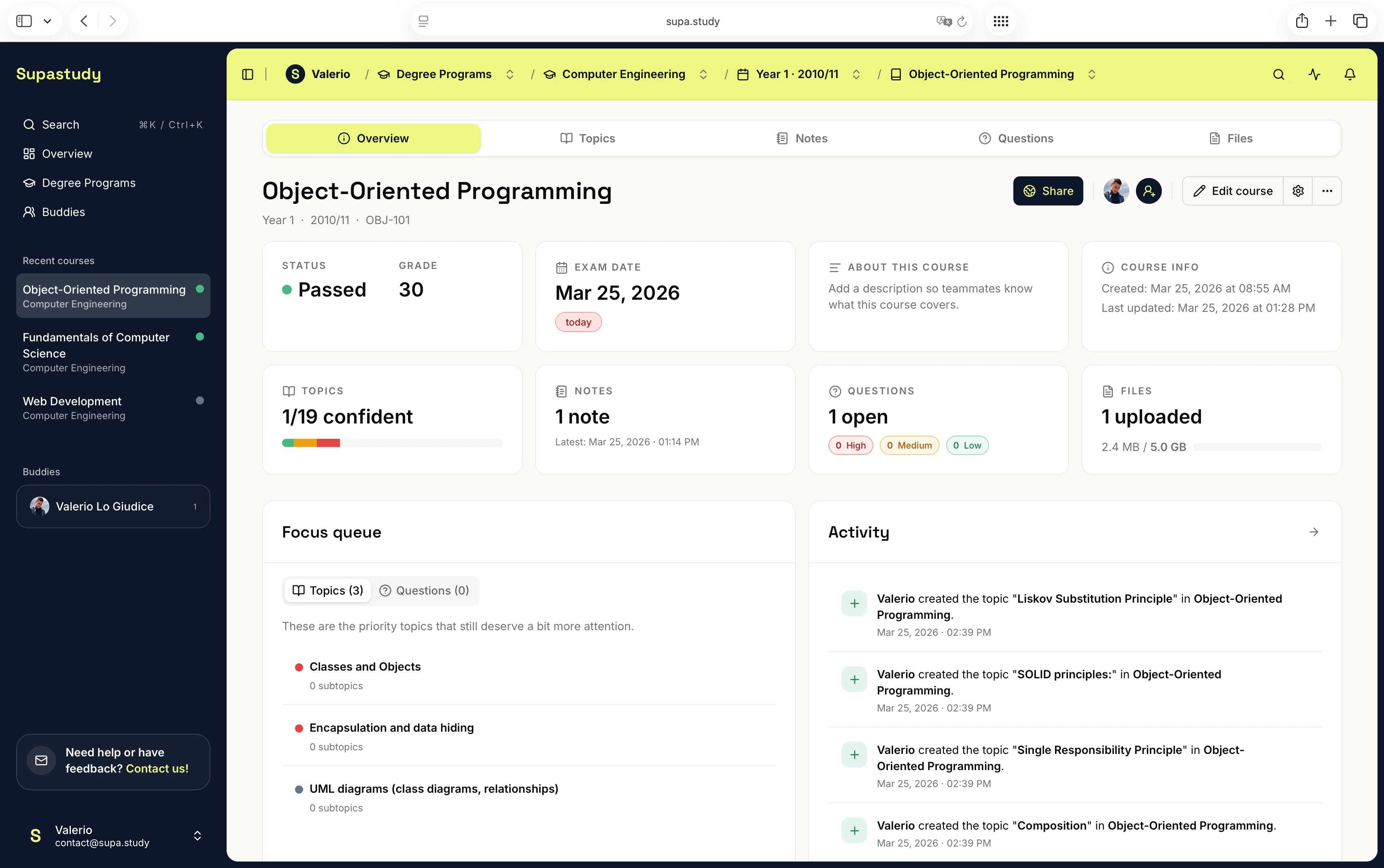
A better approach is to structure each course first. The syllabus should become topics. Notes should attach to those topics. Files should live in the same course. Open questions should stay visible. Only once each course is visible in its own right does cross-course prioritization start to make sense. Otherwise, the student is comparing vague impressions instead of comparing real material.
Compare readiness, not just exam dates
Exam dates matter, but dates alone are not enough. Two courses may be one week apart, yet one may already be well organized while the other still has large gaps. If students plan only by calendar, they often overinvest in the course that looks closest and underinvest in the course that is structurally weaker.
A stronger system compares both time and readiness. Which courses already have a stable topic tree? Which still have chapters with no notes? Which have unresolved questions that keep returning? Which have past papers attached and reviewed? These signals make it much easier to decide what deserves attention first.
This does not mean every study session has to become a precision exercise. It means the student should have enough visibility to avoid making decisions based purely on panic.
A Supastudy workflow example
In Supastudy, one practical multi-exam workflow starts by setting up each active course with its own topic tree, exam date, notes, files, and questions. Once that exists, the student can review the course overviews side by side and decide where the next study block should go. One course may have the nearest exam date but already be relatively stable. Another may have more time left but several topics with no notes and unresolved questions. That difference matters.
The point is not to create a perfect ranking formula. The point is to make the comparison concrete. A student deciding between three exams should be able to see why one course needs attention now instead of relying on a vague feeling that everything is equally urgent.
How to rotate focus without fragmenting your week
A common trap is switching too often. Once students recognize they have multiple exams to prepare, they sometimes try to “touch everything” every day. That can create the appearance of balance while actually weakening depth. A better pattern is to keep the cross-course overview visible while still allowing each session to have a clear target.
One day may focus on closing content gaps in the weakest course. Another may focus on difficult questions in the course with the nearest exam. Another may be used to attach missing files and stabilize one chapter in a course that is mostly organized but still uneven. The exact schedule varies, but the principle is stable: visibility across courses should improve decisions, not force constant context-switching.
Common mistakes in preparing for several exams
One mistake is comparing courses emotionally rather than structurally. Some subjects simply feel heavier than they are, while others feel manageable until the missing notes start causing problems. Another mistake is using one planning tool for deadlines and different disconnected systems for the material itself. That separation makes every prioritization step slower.
Students also lose control when they treat all courses as though they need the same kind of work. One course may need note-building. Another may need question resolution. Another may mainly need targeted revision with past papers. Multi-exam preparation gets better when students stop using one generic study label for every subject and start seeing the real kind of work each course requires.
What to read next
For the single-course exam-planning foundation, read How to Build an Exam Study Plan From Your Syllabus. If your biggest issue is still course structure, start with How to Turn a Syllabus Into a Study Plan. If notes are slowing revision, go to How to Link Notes to the Right Chapter So Revision Is Faster. For the broader category view, What Is a Study Planner for University Students? gives the product-level context.
Final takeaway
Preparing for multiple university exams at once becomes much easier when students can compare real course readiness instead of reacting only to calendar pressure. Dates matter, but the quality of the course structure matters just as much.
If you want to manage several courses inside one academic workspace, you can start for free. If you want the plan details before setting things up, visit the pricing page or the FAQs.